How to Turn One Construction Project Into a Wealth of Marketing Content
“We just don't have time to create content.”
Most commercial contractors say this when I ask about their marketing. I understand that. You're running projects, managing teams, chasing the next projects for your pipeline. Writing blog posts, updating your website, and designing infographics for social media posts isn't what you got into construction to do.
But, the problem isn't time. The problem is that nobody has ever shown you how far one good piece of content can actually go.
The Opportunity Most Construction Companies Miss
Every completed project contains a full year's worth of marketing material. The challenge your team navigated and the solution you engineered. The decision your superintendent made at the worst possible moment. The thing the owner said at closeout that you should have written down. That's your content, and most of it is sitting untouched in your project files, your team's heads, and your photo archives.
The mistake isn't failing to create content. It's treating each piece of content as a one-time event. You write it once, post it once, maybe mention it in a proposal, and move on. The story gets used once and then retired.
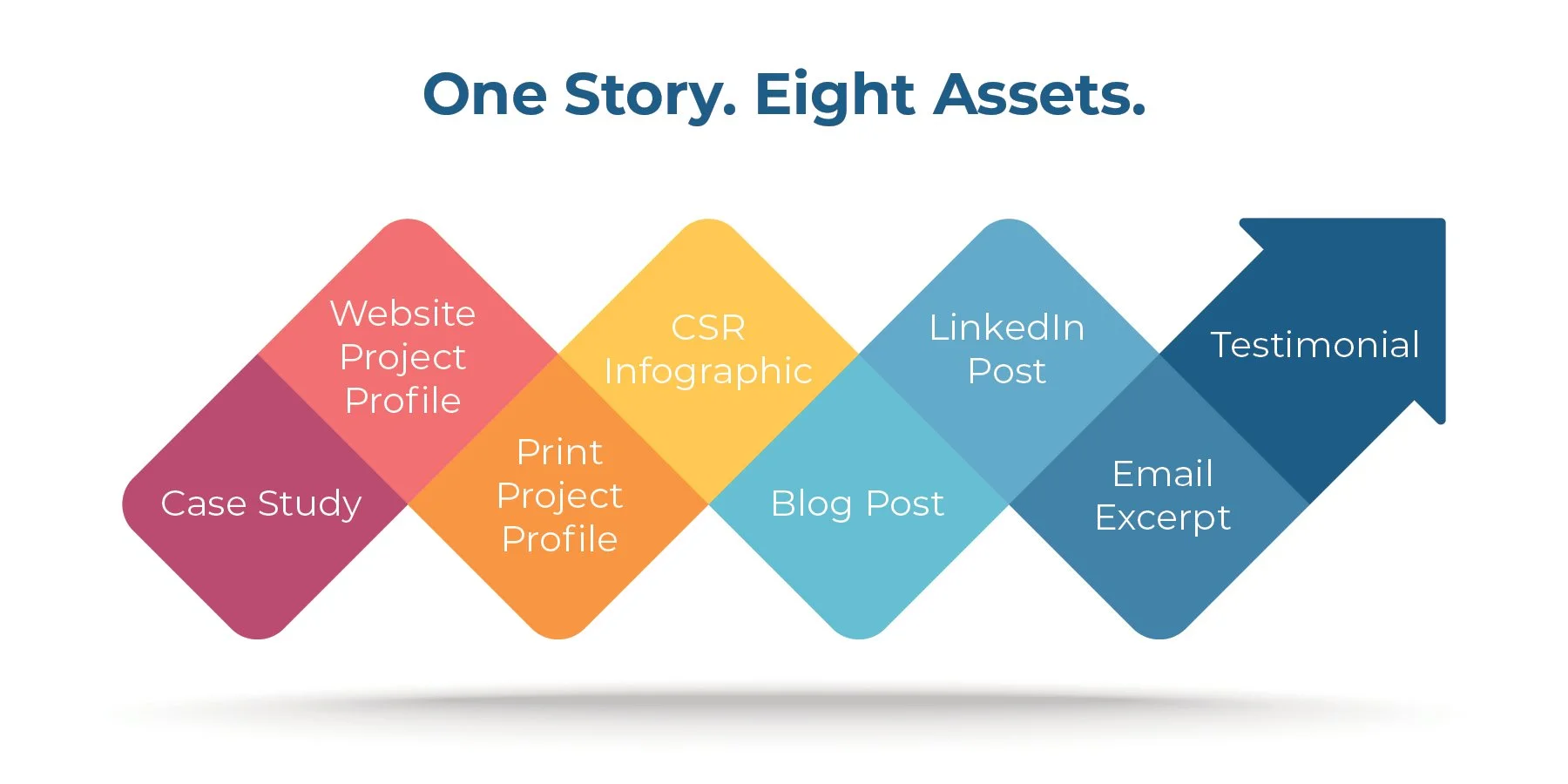
What if that same story could become eight distinct marketing assets—each one formatted for a different audience, a different channel, a different moment in your buyer's decision process—without you starting from scratch eight times?
That's exactly what content repurposing makes possible. And it's simpler than it sounds.
One Story. Eight Assets.
Here's a real-world example of how this works.
A commercial general contractor completes a 42,000 SF healthcare renovation—an occupied facility, phased construction, 14-month hard deadline. The project went well. The owner was pleased. Your team handled some genuinely complicated situations without the owner ever losing sleep over it.
That single project story can become:
1. A full case study: 1,200 words covering the challenge, your solution, the measurable result, and an owner quote. This is your source document, the well you draw everything else from.
2. A website project profile: A condensed 300-word version with project stats, a summary paragraph, and four photographs. Lives on your portfolio page and gets indexed by search engines every day.
3. A printed leave-behind: The same project prodile formatted as a clean, professional one-pager that your BD director brings to interviews and includes in proposal packages. It does work in the room when you're not there. Save it as a high-res PDF and it can be emailed or even used as a downloadable asset on the website project profile page.
4. A challenge / solution / result infographic: Three sections, one sentence each: what made the project hard, what your team did about it, and what the measurable outcome was. This works on your website, in presentations, and as a standalone social media graphic.
5. A blog post: Not a project recap, but a thought leadership piece drawn from the project. Something like: “What 14 Months in an Occupied Hospital Taught Us About Construction Communication.” The project story is the example. The transferable insight is the content. Link it to your website project profile to keep visitors on your site longer. If you print a quarterly newsletter, this can become your feature article with a photo or two.
6. A LinkedIn post: One moment from the project, told in two paragraphs. A conversation with the charge nurse. The call your superintendent made when the schedule slipped. Something specific and real. Link it back to the blog post for those who want to go deeper. This has the side benefit of increasing traffic to your website and giving visitors an opportunity to look at other pages on your site.
7. An email excerpt: A brief introduction (teaser) to the story with a link to the full case study or blog post, dropped into your monthly newsletter to the owners and prospects on your list.
8. A testimonial: Genuine praise from a real client can be used in a website module, on your social media channels, and in proposals. Ask the owner to post it to review sites online by providing the links.
Eight assets from one project story. One story. Roughly 8 to 10 hours of production time, spread across a month or two. And once built, these assets work for your company for years on search engines, in proposals, on LinkedIn, and in presentations. Do this for every project and you can see how it amplifies your expertise.
None of this requires a marketing department. It requires four operational moments built into how your company already works:
• A 15-minute project closeout debrief that captures the challenge, the solution, and the result before your team moves on to the next job.
• A professional photography session at substantial completion.
• A reference call with the owner within 30 days of closeout.
• And one hour, once a month, with whoever owns your marketing (even if that's you) to decide which story to develop next.
Everything else flows from those four moments. When you systematize your marketing, it doesn't seem like so much work after all.