Owners Aren't Evaluating Your Capabilities. They're Evaluating Their Risk.

Technical competence gets you a seat at the table. It does not get you the job.
If you’ve sat in a pre-bid meeting, poured weeks into a proposal, or waited by the phone for a selection committee's call, you have felt that pressure. You know your company is qualified. Your team is experienced. Your safety record is solid.
But so are your competitors'.
In today's commercial construction market, being qualified is the price of admission. When a selection committee sits across the table from a shortlist of capable contractors, they are not asking 'Who can build this?' They are asking a very different question: 'Who is the least likely to make us regret this decision?'
Owners are not just evaluating your capabilities. They are assessing their risk. And the single most powerful way to reduce that perceived risk has nothing to do with your capabilities statement, your safety metrics, or your years in business. It has to do with trust — and trust is earned before the proposal is ever submitted.
The question that wins commercial work is not 'Who can build this?' It is 'Who will we regret the least?' Trust is what answers that question, and trust cannot be written into a proposal.
The New Currency: Social Proof
Your most valuable business development assets are not the things you create. They are the things you earn. Testimonials from owners who trusted you. Case studies that document what you actually delivered. References who answer the phone when a selection committee calls and say exactly what you would want them to say.
This is social proof—the principle that people under pressure look to the experience of others to guide their own decisions. In commercial construction, where the stakes are high and the consequences of a bad contractor selection can run into millions of dollars, social proof is not a nice-to-have. It is the deciding factor.
Two Scenarios. One Very Different Outcome.
SCENARIO A
A selection committee reviews your proposal. It is comprehensive, with detailed scope breakdowns, safety data, years of company history, a list of completed projects. The committee is anxious. They have a $15 million project to award and three qualified contractors in front of them. They read through your RFQ and think: “They seem fine. But so does everyone else.” Without external validation, they default to whoever they have worked with before, or whoever is the cheapest.
SCENARIO B
The same committee reviews your proposal. Alongside your scope and qualifications, they find a documented case study from a project nearly identical to theirs—same market sector, same complexity, similar owner profile—with a written testimonial from that owner describing specifically how your team handled a scheduling challenge that could have derailed the project. There is a reference who is ready and willing to take their call. The risk equation shifts. You are no longer an unknown quantity. You are the contractor someone just like them already trusted, and would trust again.
The difference between those two scenarios is not qualifications. It is documented, organized, deployable social proof. And most commercial contractors have the raw material for Scenario B sitting unused in completed projects they never fully leveraged.
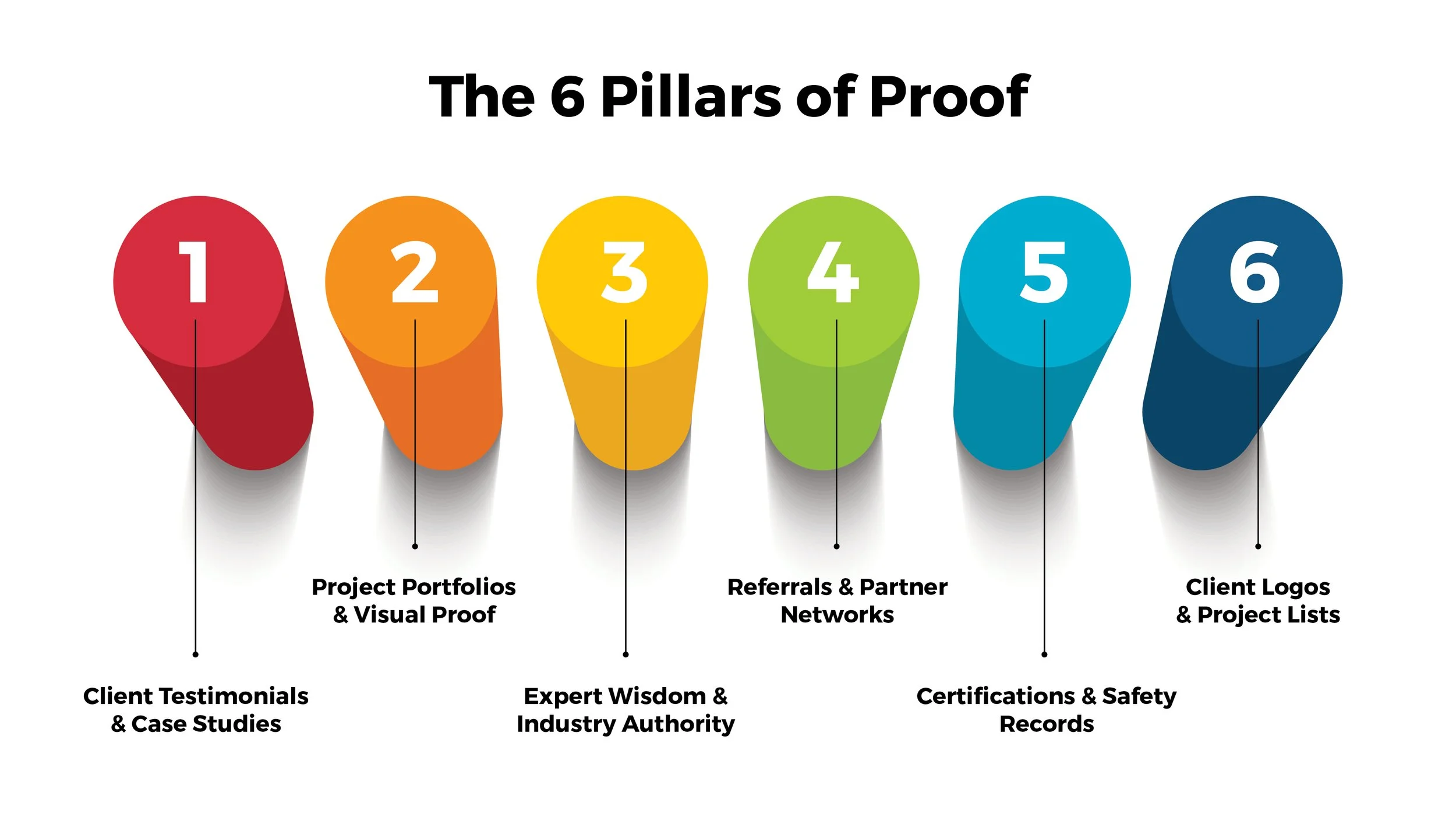
The Six Pillars of Proof: Your Arsenal of Influence
Building this trust isn't a mystery. It's a strategic process of collecting and showcasing proof. Think of these as the six foundational pillars of your firm's reputation:
Client Testimonials & Case Studies: This is your proof of concept. A case study isn't a story; it's an evidence file that demonstrates, with data, that you do what you say you will do.
Project Portfolios & Visual Proof: A single, high-resolution photo of a flawless installation says more than a thousand words about your quality. Drone footage and virtual tours make your capabilities tangible.
Expert Wisdom & Industry Authority: Awards, speaking engagements, and media features are deposits of credibility into your brand’s bank account, signaling that experts recognize your excellence.
Referrals & Partner Networks: A warm introduction from a trusted architect or past client is the closest thing to a guaranteed win—a direct transfer of trust.
Certifications & Safety Records: Your ISNetworld status, safety record (EMR and LTAs), and safety awards are public declarations that you operate at the highest level of professionalism and you care about your employees' well-being.
Client Logos & Project Lists: Displaying high-profile client logos triggers a powerful psychological response: “You are in good company.”
How Petra Helps
When a new opportunity enters your pipeline—a healthcare renovation, a data center fit-out, a new higher education facility, a municipal project—Petra's CRM and Project Portfolio help you immediately identify which completed projects are most relevant and which owners are the strongest references for that specific pursuit. Social proof stops being generic and becomes targeted. The CTC Framework™ makes social proof collection a built-in process. It treats post-project relationship management as a defined stage, not an afterthought. Gathering testimonials, completing case studies, and maintaining owner relationships are built into how Petra members operate, so that by the time the next relevant RFP comes out, the social proof is already there.
Qualification gets you considered. Trust gets you selected. And trust, in commercial construction, is built from the accumulated weight of what owners who have worked with you are willing to say about the experience. The contractors who win consistently are not always the most technically qualified on the shortlist. They are the ones who walk into the selection process with a documented record of trust that makes the committee's risk calculation easy.
Build that record systematically. Start with the project you just finished.