The True Cost of Inaction: Why Delaying Strategic Marketing Is A Costly Mistake

As a construction leader, you’re an expert at quantifying risk. You meticulously calculate project budgets, forecast material costs, and manage safety protocols to protect your people and your bottom line.
But there’s one critical, often unquantified, risk that could be eroding your company’s value right now: the cost of inaction in strategic marketing.
This isn’t about the cost of a failed ad campaign or a poorly designed website. This is about the far greater, silent cost of doing nothing—of continuing to rely on outdated, unpredictable methods for generating business.
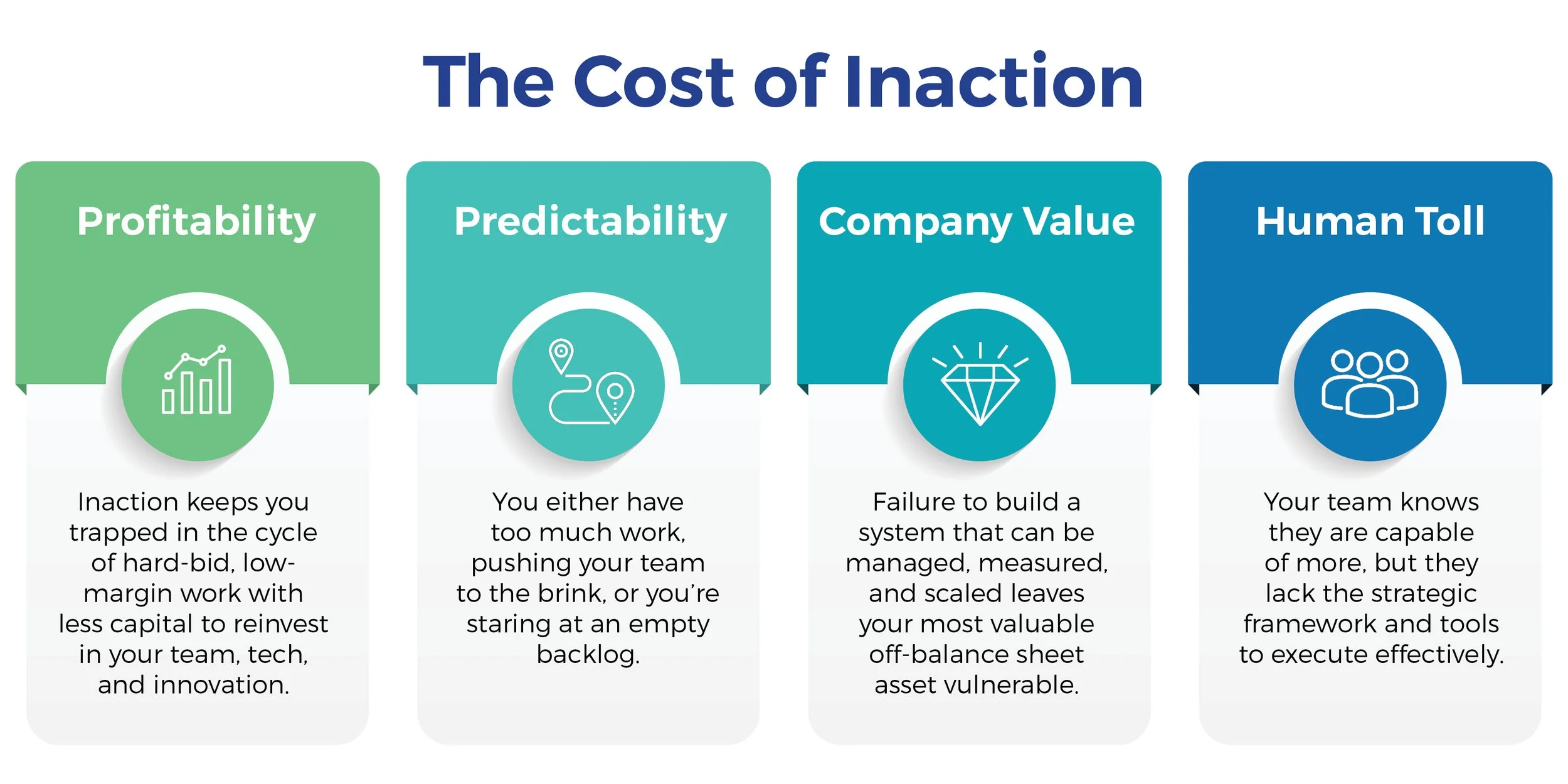
While it feels safe to avoid investing in a new “marketing fad,” the status quo is actively working against you. The true cost of inaction is measured in four key areas: profitability, predictability, enterprise value, and your most valuable asset—your people.
1. The Profitability Drain: The Commodity Trap
Inaction keeps you trapped in the cycle of hard-bid, low-margin work. When your marketing relies on responding to public RFPs or chasing projects where you’re one of many bidders, you are forced to compete on price. Your company’s exceptional workmanship, expertise, and problem-solving abilities become irrelevant in a race to the bottom.
The Cost: Your margins shrink. You’re working harder for less profit, leaving less capital to reinvest in your team, technology, or innovation.
How Petra Solves It: Petra’s Go/No-Go Calculator helps you identify which opportunities are worth pursuing and which will trap you in the commodity cycle. By scoring every RFP against your ideal client profile and profitability targets, you stop wasting estimating hours on low-margin bids and start focusing on the work that actually pays.
The cost of inaction is the millions of dollars in potential profit left on the table by not building a system that attracts high-margin, negotiated work.
2. The Predictability Problem: The Feast-or-Famine Rollercoaster
Without a system, your pipeline is a constant source of stress. You either have too much work, pushing your teams to the brink, or you’re staring at an empty backlog, forcing you to take any project that comes along just to keep the lights on.
This reactive mode makes strategic planning impossible. How can you confidently invest in new equipment or hire top talent when you have no visibility into your revenue six months from now?
The Cost: Inability to plan for sustainable growth. You miss strategic opportunities because you’re either too busy or too desperate. Your company’s growth becomes chaotic, driven by chance rather than choice.
How Petra Solves It: Petra’s Pipeline Tracker and CRM work together to give you real-time visibility into every opportunity—from first conversation to signed contract. You’ll see exactly where your pipeline is healthy, where it’s thin, and what needs attention before you’re in panic mode. No more feast or famine. Just predictable, manageable growth.
The most resilient companies are not built on luck, but on systems that create a predictable revenue engine. Petra is that system.
3. The Company Value Erosion: Your House of Cards
You’ve built a great company, but is its future tied to the personal relationships of one or two key people? This is what we call the “house of cards” problem.
If your star business developer or rainmaker leaves, does a significant portion of your revenue walk out the door with them? To a potential acquirer or investor, this revenue concentration is a massive red flag. It signals that your business is not a scalable, transferable asset, but a collection of individual efforts.
The Cost: A significantly lower valuation. A business dependent on heroes is inherently risky and less valuable.
How Petra Solves It: Petra institutionalizes your relationships. Every client interaction, every follow-up task, every project case study lives inside the platform, not in someone’s email inbox or on a spreadsheet. When your team changes, your relationships don’t disappear. Your CRM tracks every contact’s interaction and maintains history across years of touchpoints.
The cost of inaction is the failure to build a system that can be managed, measured, and scaled. Petra turns your company’s most valuable off-balance-sheet asset—your relationships—into something institutional and transferable.
4. The Human Capital Toll: Burnout and Wasted Potential
Finally, and perhaps most critically, is the cost to your team.
Your best people are spending their time chasing low-probability bids instead of nurturing high-value relationships. Your leaders are burning out, managing the chaos of a volatile pipeline. You’ve likely invested in a CRM that nobody uses, creating frustration and wasting resources. Worse yet, you may not even have a CRM and have no depository for your contacts.
The Cost: Decreased morale, high turnover, and wasted human potential. Your team knows they are capable of more, but they lack the strategic framework and tools to execute effectively.
How Petra Solves It: Petra is built for commercial contractors, not generic sales teams. Your team will actually use it because it speaks their language: a pipeline tracker, a go/no-go calculator, a project portfolio and case study creator, a BD messaging hub with pre-loaded templates and conversation tracking, goal setting, and KPIs and analytics. Your marketing plan is auto-generated from your company data, so no one has to guess what to do next.
Inaction tells your team that heroic effort is valued over systematic excellence. Petra gives them the system, so they can stop firefighting and start building.
Shifting from a Cost Center to a Strategic Investment
Many construction executives view marketing as a discretionary expense: a cost center to be minimized. This is the fundamental misunderstanding that drives the cost of inaction. Strategic marketing is not a tactical expense. It is a core operational system, just as critical as project management or safety.
The Contacts to Contracts Framework™ positions marketing as the operating system for growth. It’s not about random acts of marketing, but about building a repeatable machine:
The Attract pillar builds market authority, so clients seek you out.
The Convert pillar creates a systematic process for turning opportunities into contracts.
The Scale pillar turns your project successes into a self-reinforcing marketing flywheel.
And here’s the key difference: You don’t have to learn the framework first.
Petra has the Contacts to Contracts Framework™ baked directly into the platform. You enter your company information and Petra builds your marketing plan. You’re not taking courses. You’re running your business. The framework works in the background.
The Question You Need to Ask Yourself
The question is no longer, “Can we afford to invest in a strategic marketing system?”
The real question is: “Can we afford the staggering cost of continuing to do nothing?”
The cost of lost profit. Unpredictable pipelines. A devalued company. A burned-out team.
That cost is simply too high.
The future of your company will not be built by chance. It will be built by choice. The choice to invest in a system that delivers predictable growth, protects your enterprise value, and allows your team to do their best work.
Petra is that system.