Why Most Construction Companies Don’t Have a Marketing System (And Why That's Costing Them)

Ever feel like your marketing is either an afterthought or a fire drill with no comfortable middle ground? One minute you're busy, so marketing takes a backseat. The next, the pipeline looks thin, and it's a mad scramble to get things moving.
If this sounds familiar, you're not alone. Many commercial construction companies, despite their incredible skill and precision on the jobsite, approach marketing with a casualness that can quietly cost them valuable opportunities.
It's a curious disconnect, isn't it? The same industry that meticulously plans every beam, every pour, every safety protocol often treats its marketing as an afterthought. It's rarely seen as a core discipline, a robust system, or a function that's actively managed, measured, and refined with the same meticulous care given to a project schedule.
And that gap—the chasm between the rigorous attention paid to field operations and the often-haphazard approach to marketing—is quietly costing companies opportunities they'll never even realize they missed.
The Haphazard Reality: When Marketing Just "Happens"
We've heard variations of these phrases more times than we can count:
"We've been so busy, marketing just fell by the wayside."
"Our business thrives on relationships and referrals, so we haven't really needed a formal marketing effort."
"Our marketing kind of depends on whoever has a free afternoon that week."
We're not saying this critically. These aren't bad companies. Many of them build truly remarkable projects. Their field teams are incredibly disciplined and skilled, their safety programs are stellar and their project management is rigorous.
But somewhere along the line, marketing gets relegated to an optional line item—something to dust off when the pipeline looks a little thin, rather than a deliberate, always-on process designed to ensure the pipeline never gets thin.
What does this haphazard approach look like in practice? It's marketing that happens in fits and starts: a sudden flurry of LinkedIn posts when someone feels inspired, a proposal that catches your team off guard because no one built a content library in advance, or a website that hasn't seen a meaningful update since, well, let's just say a while ago. It's a business development director buried under active pursuits, with no bandwidth left to nurture the relationships that will fuel the next wave of opportunities.
This, my friends, is the default state for more commercial construction companies than most in our industry would care to admit. But it doesn't have to be your reality.
What the Long Sales Cycle Is Really Telling You
Commercial construction boasts one of the longest sales cycles in any industry. And within that simple fact lies a profound strategic insight that many contractors overlook entirely.
From the moment an owner first dreams of a capital project to the day a contractor is formally selected, months (sometimes years) can pass. The owner conducts feasibility studies, collaborates with architects through design phases, secures funding, and develops a procurement strategy. They're building their shortlist, often long before an RFQ or RFP ever sees the light of day.
By the time the formal procurement process begins, much of the invisible work of contractor selection is already done. Relationships have been forged (or not). Impressions have been made. Reputations have been established (or left to chance). That coveted shortlist often exists in someone's mind weeks or months before it appears on paper.
This is precisely the window a systemized construction marketing strategy is designed to fill. Not the frantic RFP sprint, but the long, quiet runway leading up to it.
A contractor who is consistently visible, credible, and present during that pre-selection period starts from a fundamentally different position than one who only surfaces at bid time. They're a familiar name, a trusted voice, a company that has already demonstrated an understanding of the owner's world, the architect's concerns, and the facility manager's operational realities long before the formal selection conversation even begins.
You simply cannot occupy that powerful position without a system. Visibility that relies on motivation isn't true visibility. Credibility that comes in bursts isn't lasting credibility. Presence that vanishes when the project team gets busy isn't real presence.
The Unsaid Pain Points Nobody Asks About
One of the most crucial, and often overlooked, elements of a truly effective construction marketing strategy is a genuine understanding of what your ideal clients actually worry about. Not what they write in an RFP, but what they don't say out loud.
We've learned to listen for the concerns that never make it into the formal selection criteria:
Owners aren't just evaluating if you can build the project; they assume competence. What they're truly trying to assess is whether you'll protect them from surprises like cost overruns, schedule delays, and communication breakdowns that leave them scrambling to explain something to their board. They want a contractor who delivers hard news early and often, who manages complexity without making them feel out of control.
Architects have been burned by contractors who treated drawings as suggestions, clashed with clients, or used RFIs as deflection tactics. Their quiet question is: Will this contractor protect the design intent in the field?
Facility managers worry about disruption like unplanned shutdowns, poor phasing, or contractors who don't understand that the loading dock needs to be clear on Tuesday mornings for cafeteria deliveries.
Most construction companies' marketing speaks to none of this. It talks about the company, not to the client's deepest concerns.
What a Construction Marketing System Actually Looks Like
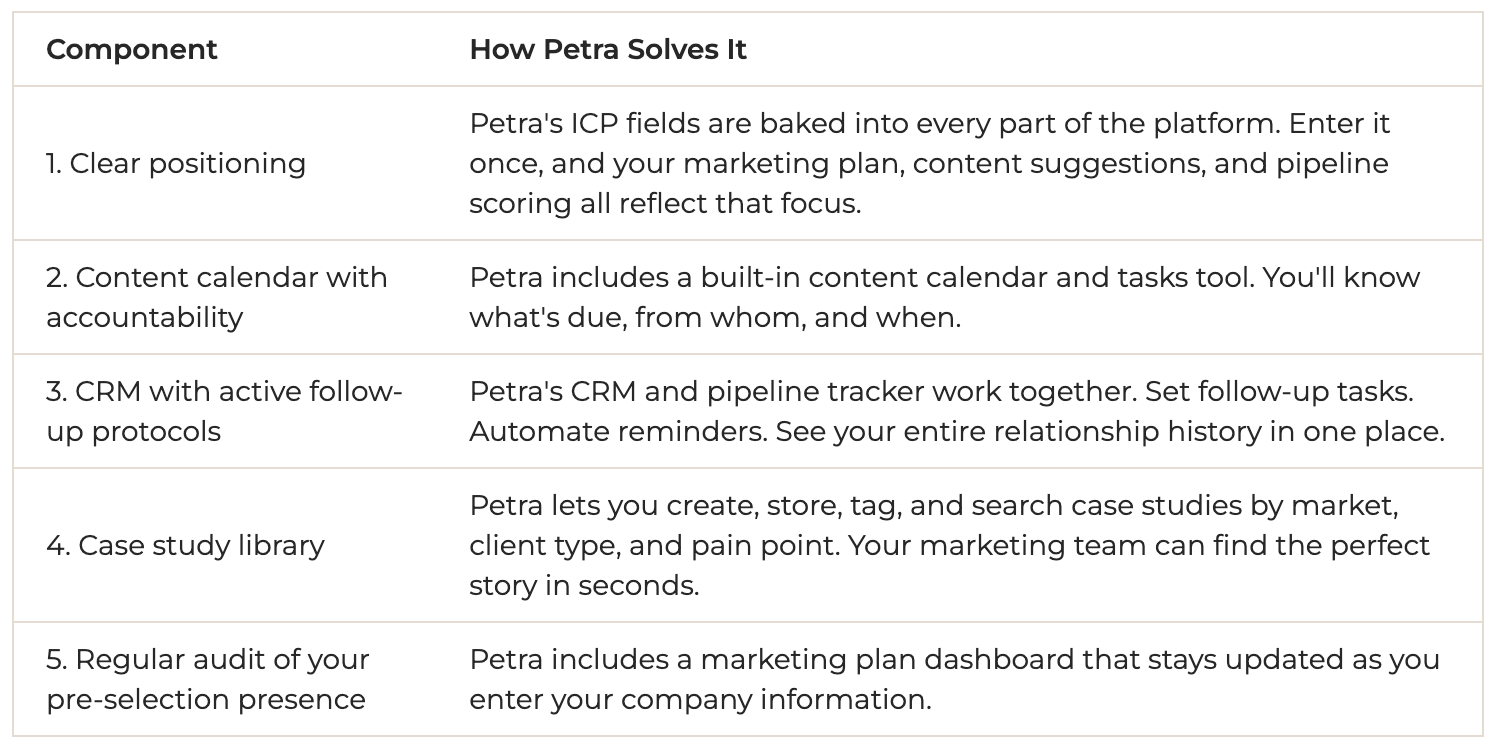
A marketing system is more than just a rebrand, a new website, a social media calendar, or a monthly agency retainer. It's a set of repeatable processes that keep your company visible, credible, and present—consistently, regardless of how full your project calendar might be. At its heart, a construction marketing system has five essential components:
A system takes the guesswork, the memory, and the "someone will get to it eventually" out of marketing.
Why This Matters More Today Than Ever Before
The commercial construction market has undeniably shifted. Owners are conducting more research earlier in the process. Architects are building digital shortlists before making that first call. Facility managers are searching for contractors just like they search for any other service provider, and they are forming opinions based on what they discover online.
The wave of retirements reshaping our industry's workforce has also disrupted the traditional relationship networks that once generated reliable streams of repeat and referral work. The seasoned professionals who held those relationships are moving on. Their replacements expect to find you online, to read case studies that mirror their own project aspirations, and to encounter a brand presence that truly reflects the quality of work you deliver in the field.
The contractors who are consistently winning the right work—not just the work that happens to find them—have adapted. They've built systems and they show up consistently in the places their best clients are looking.
Those still marketing by accident aren't necessarily failing. But busy isn't the same as strategic. And in a market where pre-selection decisions are made earlier, with less reliance on long-standing personal relationships, the gap between a contractor with a robust marketing system and one without is widening every single year.
If your construction marketing currently resides solely in someone's head or only springs to life during a slow week, the place to begin isn't with a new logo or a website overhaul. It's with a system.
How Petra Delivers Each Component
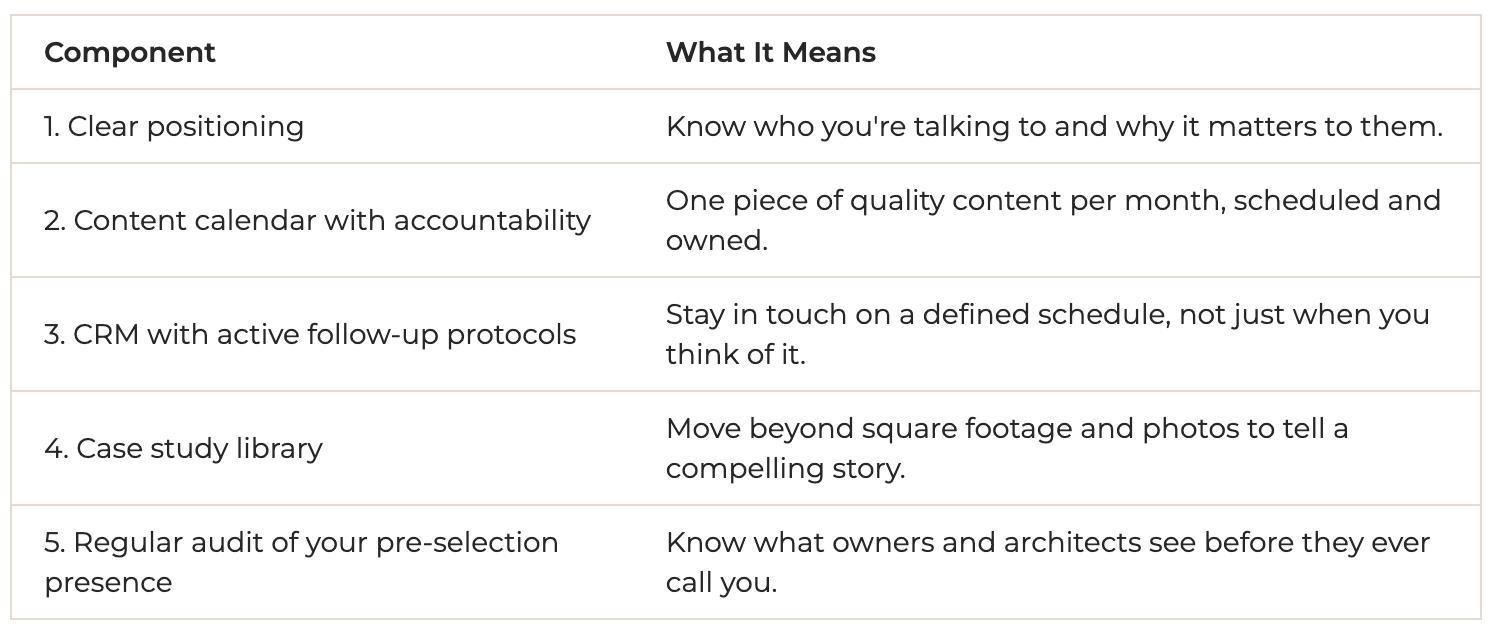
Petra is an all-in-one marketing platform built specifically for commercial contractors. It gives you a single place to manage your CRM, track your pipeline, create your case studies, and automate your client follow-ups, so marketing isn't something you remember to do. It's just how you run your business.
Inside Petra, you can also tag every case study, every project story, and every piece of content by the specific pain point it addresses. When your marketing team is preparing for a meeting with a facility manager, they can pull up every project where you successfully managed occupied-space logistics—in seconds, not hours of searching.
Petra puts all five components in one place. Your ICP (Ideal Client Profile), your UVP (Unique Value Proposition), your CRM, your project portfolio, your pipeline tracker, and your client touchpoint schedule all live in one platform. You don't have to remember to stay visible because Petra reminds you, tracks it, and shows you exactly where you stand.
No more Frankenmarketing. No courses to complete first. No spreadsheets to build. You just enter your company information, upload your contact data, enter the projects in your current pipeline, and Petra builds your marketing plan, tracks your pipeline, and helps you stay consistently visible to the clients who matter most.
The most successful contractors build great marketing systems. Petra gives you the CRM, pipeline tracker, content calendar, and case study library you need to stay visible, credible, and present—all in one platform built for commercial construction.