A project executive retires. A BD lead takes a job across town. Within a month, the team discovers how much of its pipeline lived in one person's inbox, phone, and memory.
Most commercial contractors don't have an activity problem. They have campaigns, proposals, spreadsheets, and meeting notes. What they're missing is a system and a shared way to answer four questions:
Who should we pursue?
Which relationships matter most?
What proof can we show?
What happens next, and who owns it?
When those answers are scattered across personal inboxes, estimating files, marketing folders, and hallway conversations, the work is hard to see and harder to repeat.
Construction raises the stakes. Pursuits run for months or years. Buying groups include owners, developers, architects, committee members, and facility managers. Relationships outlast any single project. In this industry, a documented system isn't bureaucracy. It's how context survives.
What a System Is, and Isn't
A construction marketing and BD system won't guarantee more leads or better project outcomes. What it does is make your current work visible: the markets you want to serve, the people you know, the opportunities you're weighing, the proof you can use, and the next actions the team has agreed to take.
The check-up below takes about 30 minutes in your next marketing, BD, or leadership meeting. It shows where your system already works, and where the team is running on memory, urgency, or one person's inbox.
The Five Parts of a Functioning Marketing and BD System
1. Market focus: Where are you trying to earn attention?
A useful system starts with choices. Your team should be able to name the markets, geographies, project types, delivery methods, and relationship types it's prioritizing. “We serve everyone” can't guide a content plan, a relationship plan, or a pursuit decision.
Focus doesn't mean turning away every project outside it. It means a shared starting point for deciding where to invest time and resources. A healthcare renovation contractor needs a different relationship map and proof library than a company pursuing municipal site work, multifamily, or negotiated industrial projects.
Ask: Can marketing, BD, and leadership each describe our priority work in the same terms?
Warning sign: Three people give three different answers.
30-day fix: Write the current working focus on one page. The three pillars of Petra's Contacts to Contracts Framework™ is one way to structure that conversation before adding more tactics.
2. Relationship record: Would you lose context if a key person left tomorrow?
Commercial construction relationships have history. A contact may know your company from word of mouth, an industry event, a proposal interview, a subcontractor introduction, or a prior job. That context shouldn't have to be rebuilt from someone's memory when the next opportunity appears.
A shared record doesn't need to be complicated. At minimum, it shows the company, the people involved, the last meaningful interaction, the relevant project or market context, and who's responsible for the next step.
Ask: For the 10 relationships most tied to current pursuits, can anyone on the team find the context and next step without asking the original relationship owner?
Warning sign: "Ask Mike. He knows them."
30-day fix: Document those 10 relationships and assign an owner to each. Petra's marketing guidance and business-development guidance offer role-specific starting points.
3. Opportunity discipline: Does every pursuit have a reason, an owner, and a next decision?
A full pipeline isn't automatically a useful one. A list of possible work becomes actionable when the team can tell an early relationship from an active opportunity, identify the decision maker or buying group, record the next milestone, and decide whether the pursuit still deserves time.
This matters most when invitations, referrals, and “keep us in mind” conversations arrive steadily. The goal isn't to remove judgment. It's to make judgment visible so the team acts consistently.
Ask: Can we explain why each active pursuit is still active, who owns the next step, and when we'll revisit the decision?
Warning sign: Pursuits stay “active” because no one ever decided to drop them.
30-day fix: Agree on three questions every pursuit must answer before it enters the active pipeline. A simple Go/No-Go Assessment helps frame them; for the tradeoffs, see Petra's construction go/no-go decision framework.
4. Proof library: Can you back up your story on short notice?
Marketing and BD teams get asked for a project sheet, case study, qualifications response, presentation slides, or follow-up note, usually with little warning. If project facts, photos, testimonials, team experience, and lessons learned are buried in closed-out job folders, the team either rushes to recreate material or falls back on vague claims.
A proof library is an organized collection of approved project facts and reusable story ingredients. It shows what's verified, what has permission to be shared, and what still needs review. It shouldn't turn every completed project into a claim of superior performance.
Ask: Could we prepare a fact-checked, audience-relevant project story this week without asking a project team to recreate the history?
Warning sign: Every qualifications package starts with an email to a PM: "Do you have photos from that job?"
30-day fix: Pick one completed project and build an approved source file before writing any new case-study copy. Once the facts are ready, the one story, eight assets article shows how to get more from them.
5. Operating cadence: Does the work have a regular home?
The most common system failure isn't a lack of ideas. It's a lack of cadence. Nobody needs another meeting for its own sake, but marketing, BD, and leadership need a predictable time to look at the same information and make decisions.
A weekly review can be short. A workable agenda:
New relationships and their context
Active pursuits and their next stages or milestones
Upcoming marketing and BD events and content
Proof (case studies, project profiles, etc.) waiting for assets or approval
Decisions that have stalled
Leadership doesn't need to own every task, but it should see the decisions and constraints that need its input.
Ask: Is there a recurring forum where marketing, BD, and leadership review the same information and agree on next actions?
Warning sign: Decisions surface only when someone gets frustrated.
30-day fix: Put a recurring 30-minute review on the calendar with a fixed agenda. Petra's C-Suite and leadership overview explains how a shared operating view gives leaders visibility without making them the owner of every task.
How to Run the 30-minute Check-Up
Who's in the room: your marketing lead, your BD lead, and at least one executive. If you can, add an estimator or project executive who touches pursuits.
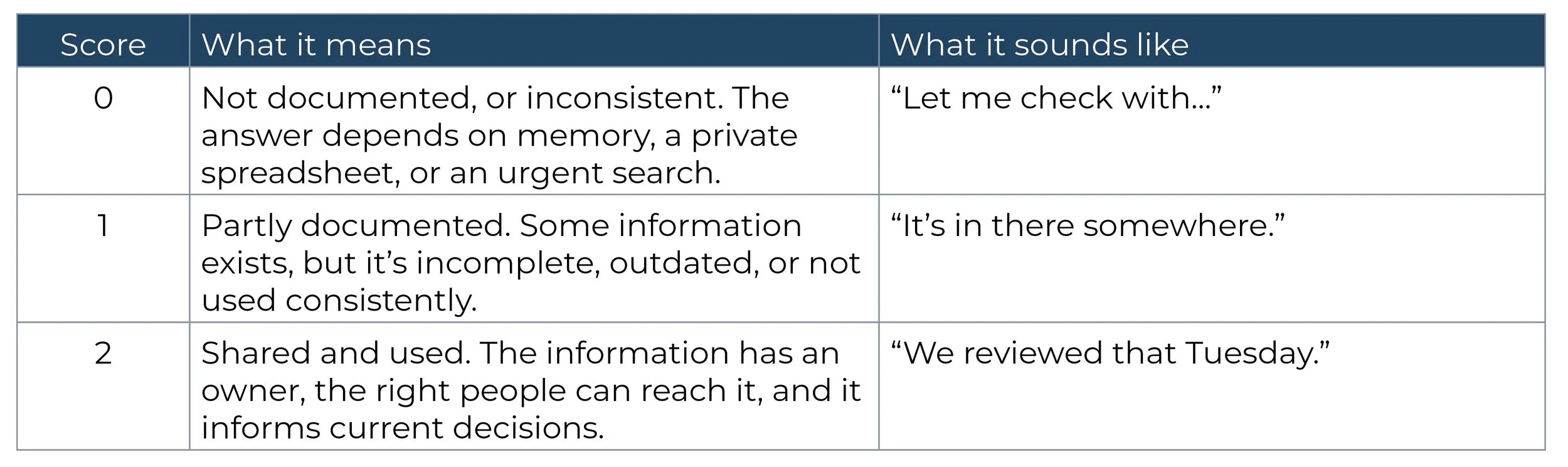
Minutes 0–5: Set the ground rules. Score what's true today, not what's planned. No one defends their department; the goal is to find the gap.
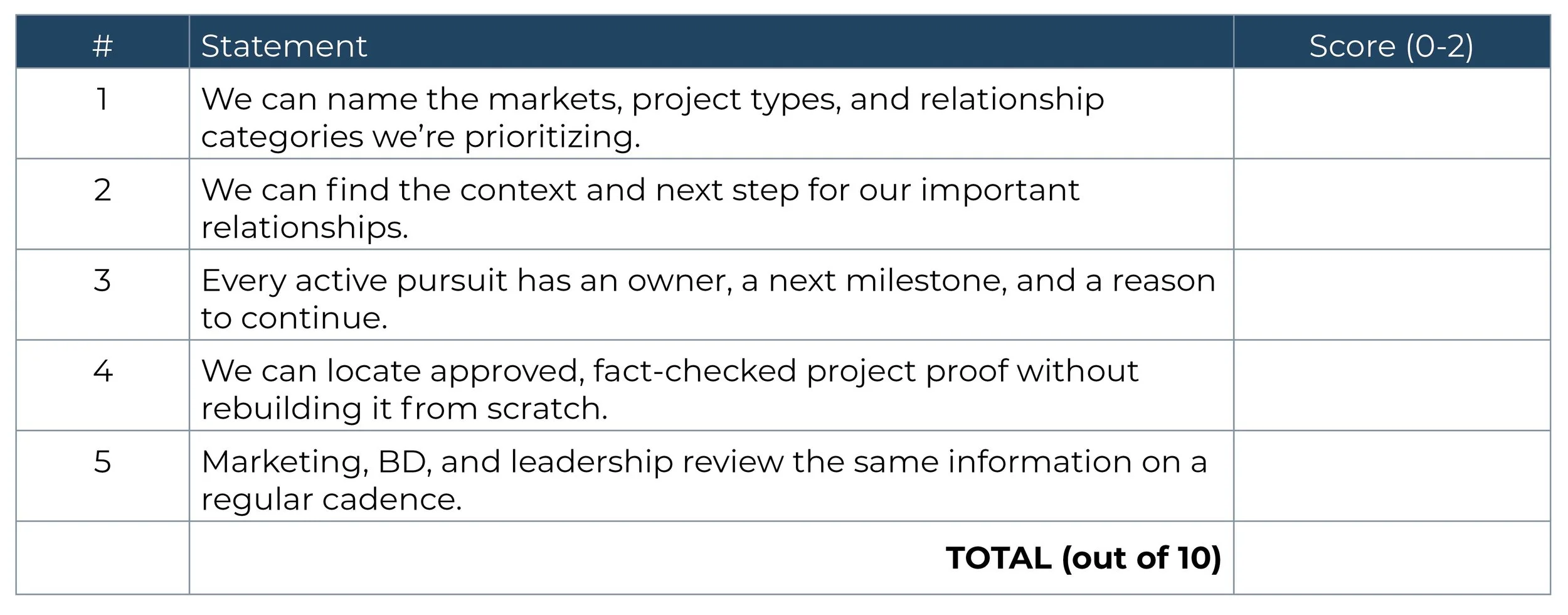
Minutes 5–12: Score silently. Each person scores the five statements on their own, before any discussion.
Minutes 12–25: Compare. Start where scores differ most. When marketing gives a 2 and BD gives a 0, the disagreement is itself a finding.
Minutes 25–30: Commit. Pick one area, one owner, one observable improvement, and a review date 30 days out.
The Scorecard
Reading your result
A score is not a maturity badge and it does not predict wins. It tells you where to start improving.
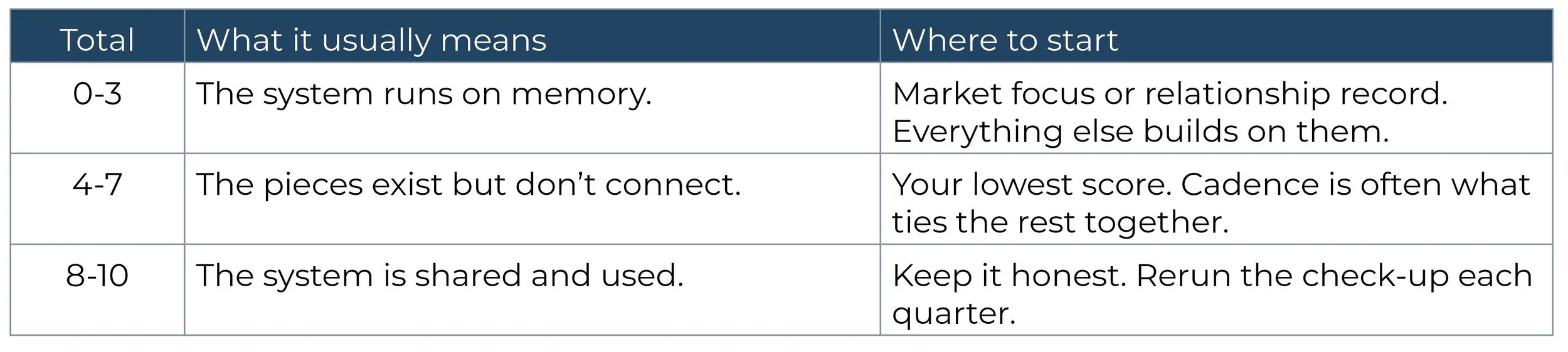
Whatever your total, your lowest-scoring area is the next move. Assign one owner and define one improvement someone could observe within 30 days. The 30-day fixes under each part above are good places to begin.
Not That: What a System Shouldn't Become
A good system earns its keep by being useful, not by being full. It shouldn't:
Create data entry just to make a dashboard look complete
Claim that every marketing activity caused a project award
Force a long, relationship-driven sales cycle into a generic sequence
Replace the judgment of estimators, project executives, operations leaders, or relationship owners
Its job is narrower and more practical: preserve context, clarify decisions, and create a shared next step.
That visibility also helps with concentration risk. If several active relationships, pursuits, or upcoming decisions hinge on one client, one market, or one referral source, the team can see the dependency and decide whether it needs a broader relationship plan. For more on that, read Is Revenue Concentration Putting Your Company At Risk?.
Start With One Decision This Week
Don't start by rebuilding every spreadsheet or launching a marketing campaign. Start with one real decision:
Which relationship needs its context written down?
Which pursuit needs a go/no-go conversation?
Which completed project needs its proof organized?
Which market deserves a clearer focus so we can identify ideal clients?
Give that decision a visible owner and a review date. That's the system beginning to work.
Petra is a marketing and business-development platform built for commercial contractors. If your team is ready to bring relationship context, pursuit decisions, and marketing work into one connected operating system, start your free 7-day trial.