The short answer
Commercial construction heads into 2027 on a split market. Data centers are carrying most of the growth, while commercial spending outside them is forecast to grow about 1%. For most contractors under $100 million, that means a flat pipeline, so win rate by work type and the true cost of every pursuit matter more than bid volume.
I've been implementing marketing programs for commercial contractors since 1988, and I've lost count of how many times an owner has asked me, “What's a good win rate?” My honest answer has always been “It depends,” which is about as satisfying as a change order. So this fall, we pulled together what published sources actually report, attributed every number, and built a worksheet so you can calculate your own.
This post covers the highlights. The full report, with every table, source, and the printable worksheet, is free to download.
Download the Q4 2026 Commercial Construction BD Benchmarks »
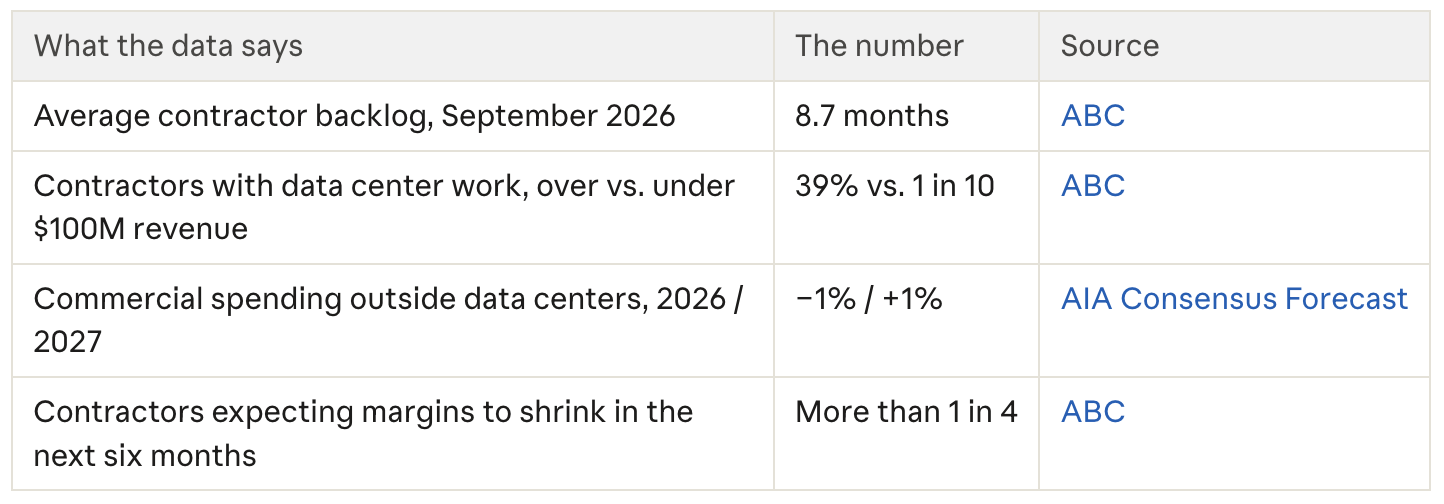
The 2027 market is K-shaped, and most contractors are on the flat leg
The national numbers look steady. Look closer, and the growth belongs mostly to the largest contractors doing data center work.
The design pipeline isn't helping either. Architecture billings have stayed below the growth line since early 2023, and AIA reported the slump deepened this fall. If much of your negotiated work comes through architects, expect a slower first half of 2027.
Here's the part I find encouraging: in a flat market, you don't grow by riding volume. You grow by winning a bigger share of the right work. That's a business development problem, and business development problems can be fixed.
There is no single “good” win rate
Anyone who hands you one industry win-rate number is selling something. Win rate moves with how the work is bought. Win-rate ranges ConstructConnect compiled from trade and consultant sources look roughly like this:
Hard-bid public: 10–20%. Low hit rates are normal here, not a performance problem.
Private competitive: 15–25%. Fit and relationships start shaping the shortlist.
Negotiated or selective: 30–50%. You were invited, so much of the winning happened before the RFP.
Repeat client: 50% and up. That's relationship strength doing its job.
That's why a single company-wide win rate can fool you. Shift 20% of your volume from hard bid to negotiated work, and your win rate climbs without your team getting one bit better at winning. Spend a year chasing more public work, and a good year looks like a decline.
The full Q4 2026 Commercial Construction BD Benchmarks Report shows how to split your win rate by work type, track your pursue rate, and record the pass reasons that reveal your real strategy. Download the full report and the proposal production cost builder here»
Every pursuit has two price tags
Most contractors know roughly what an estimate costs. A fully loaded in-house estimator runs about $107,000 to $145,000 a year, and an outsourced estimate runs $250 to $2,500. Very few contractors count the second price tag: the RFQ or RFP response itself.
I've produced more proposals than I care to admit, and I can tell you they are never free, even when nobody sends an invoice. Here's where the money goes:
Staff time. A marketing manager, a marketing coordinator, and a graphic designer build the response. A graphic designer's median wage alone is about $30 an hour before benefits. Then add the estimators, project managers, and executives pulled in for resumes, approach narratives, proofing, and interview prep.
Printing and delivery. "Please provide six bound copies and one digital file" still shows up in plenty of RFPs. Add tabs, covers, binding, and delivery.
Outside agency fees. Handing the writing, design, or interview coaching to an agency saves internal hours, but the fee per response is often higher.
Add your estimating cost and your proposal production cost for the year, then divide by the number of pursuits you chased. That's your real cost per pursuit. The first time most companies run it, the number is uncomfortable, because it turns every no-bid into a decision with a dollar sign on it.
The full report includes a proposal production cost builder, so you can price each response line by line.
Three things to do before your 2027 planning meeting
Split last year's win rate four ways. Hard-bid public, private competitive, negotiated, and repeat client. The spread tells you where your next business development dollar belongs, and it's almost never where the volume is.
Price one pursuit, honestly. Include estimating hours, proposal production, printing, and any agency fees. Then decide which no-bids you wish you'd made.
Write down your top three pass reasons. Wrong geography, no relationship with the owner, schedule, bonding, low margin, capacity. Whatever shows up most often is your real strategy, whether you planned it or not.
Get the full report
The Q4 2026 Commercial Construction BD Benchmarks Report is a free 9-page PDF built for owners, BD directors, and marketing managers at commercial construction companies. Inside:
Q4 2026 market context from ABC, AIA, CFMA, and Dodge, and what it means for BD
Win-rate ranges by work type, with what each range really reflects
Estimating and proposal production costs, plus a cost builder for each response
Sub bid coverage benchmarks and why 47% beats 9–15%
Margin context from CFMA's 2026 Construction Financial Benchmarker
A printable worksheet to calculate your pursue rate, win rate, and cost per pursuit in about twenty minutes
Every figure is attributed, and none of it is Petra's proprietary data. If you want a benchmark you can defend to your ownership group, it has to come from your own pipeline history. That's exactly why we built Petra, but the worksheet works with a pencil, too.
Frequently asked questions
What is a good win rate for a commercial contractor? It depends on how the work is bought. Published ranges run 10–20% for hard-bid public work, 15–25% for private competitive, 30–50% for negotiated or selective work, and 50% or more with repeat clients. Compare your win rate against your dominant work type, not the industry as a whole.
How do you calculate cost per pursuit in construction? Add your fully loaded annual estimating cost and your annual proposal production cost (staff time, printing, delivery, and agency fees). Divide the total by the number of pursuits you chased that year.
What does it cost to respond to an RFP? It varies by scope, but every response includes staff hours at loaded rates, often printing and courier costs for multiple bound copies, and sometimes outside agency fees. Most contractors never total it, which is why the full report includes a line-by-line cost builder.
What is the commercial construction outlook for 2027? The AIA Consensus Forecast projects nonresidential building spending up 3.0% in 2027, but commercial spending outside data centers is forecast to grow only about 1%. Contractor backlog averaged 8.7 months in September 2026, per ABC.
How many subcontractor bids per trade do you need? Three responsive bids per trade is widely described as the practical floor for a competitive number. Typical sub response rates sit at 9–15%, so coverage depends on inviting the subs who actually bid your work.
Sources
Associated Builders and Contractors, Construction Backlog Indicator, September 2026
AIA Consensus Construction Forecast, July 2026, via Design Cost Data
AIA/Deltek Architecture Billings Index
Dodge Construction Network, 2027 Construction Market Trends
U.S. Bureau of Labor Statistics, Graphic Designers
ConstructConnect, Edge Estimates, and Grogan Construction Management (cited in full in the report)