Is Revenue Concentration Putting Your Construction Company at Risk?

It’s a conversation that rarely makes it onto the executive meeting agenda, yet its implications can be catastrophic. We’re talking about revenue concentration, the quiet, often-overlooked risk that permeates the commercial construction industry. If you’re a CEO, VP, or business development director in this space, you’re likely living with it, whether you know it or not.
I’ve sat across from contractors pulling in $40 million a year, confident in their steady stream of work, yet acutely aware that 40% of that volume hinges on a single owner relationship. The work keeps coming, yes, and that feels like success. But beneath that confidence lies a gnawing anxiety: what happens if that relationship changes? This post is for them, and for anyone who wants to build a more resilient, valuable commercial construction business.
At its core, revenue concentration occurs when your company relies heavily on a small number of clients for a disproportionate share of your income. Financial advisors and CPAs often use a rule of thumb: if any single client accounts for 10% or more of your revenue, your concentration risk is elevated. If your top five clients collectively represent 25% or more of your revenue, you're in high-concentration territory.
In commercial construction, these thresholds are crossed with alarming regularity. It's the nature of the beast: large projects, long-term relationships, and the natural tendency for loyal owners to award repeat business to contractors they trust. While this loyalty is a testament to your firm's quality and service, it also inadvertently creates a structural dependency that can destabilize your company without warning.
The Risks No One Mentions Until It’s Too Late
The dangers of revenue concentration aren't always apparent during boom times. But when market shifts or client changes occur, these risks can become existential.
Your Pipeline Disappears When a Relationship Does
Consider the bedrock of your business: relationships. Owners retire. Developers pivot strategies. Key contacts move to new companies. Facility managers get replaced. Any of these events can disrupt a relationship that took years to cultivate. If that relationship is generating 30% or 40% of your revenue, the disruption isn't just uncomfortable; it's a direct hit to your bottom line and future pipeline. No amount of operational excellence can protect you from a client whose circumstances simply change.
Your Company’s Value Takes a Direct Hit
For contractors eyeing a future sale or ownership transition, revenue concentration has a precise and measurable impact on company valuation. When a single client accounts for 30% or more of your backlog, potential buyers will apply a significant discount to the valuation multiple. They see the risk that the relationship might not survive a change in ownership. They might even demand an earnout tied to client retention, essentially asking you to guarantee the continued loyalty of the relationships you built under new management. The message is clear: reducing concentration before you go to market directly enhances what buyers are willing to pay.
Your Growth Options Narrow
When your firm depends on a handful of relationships to keep your crews busy, growth becomes reactive rather than strategic. You build capacity, staff, and overhead around these relationships. The moment they slow down or pause, you're left with fixed costs and no immediate way to cover them. Sustainable growth comes from a pipeline broad enough to absorb volatility from any single client. This breadth must be built intentionally; it doesn't happen by accident.
Your Ability to Borrow and Bond Becomes Restricted
Lenders and surety companies are acutely aware of concentration risk. A company with heavy dependence on one or two clients is seen as carrying elevated risk. According to FMI, this perception can directly impact your bonding capacity, the terms of your line of credit, and your overall financial flexibility. Diversification signals stability and reduces perceived risk, making you a more attractive partner for financial institutions.
What the Numbers Tell You
From the inside, a concentrated pipeline often doesn't look like a problem. Revenue is strong, the work is familiar, and relationships are solid. But the data tells a different story: companies with diversified client bases consistently command higher valuations, access capital more easily, and demonstrate more resilient performance through market cycles. Stakeholders—lenders, investors, potential buyers—interpret revenue swings as signals of elevated risk, translating directly into a higher cost of capital and lower valuation multiples. The most successful commercial construction companies don't just respond to volatility; they build systems to prevent it.
Why Commercial Construction Is Especially Vulnerable
Unlike a retail business serving thousands of customers, a commercial contractor operates within a genuinely limited universe of buyers. Your market is defined by geography, expertise, project type, delivery method, and relationship access. Tripling your client base overnight simply isn't realistic.
This reality often makes the concentration problem feel inevitable. It isn't. But addressing it requires a deliberate strategy, not just hoping new work finds you.
The contractors I've seen successfully build genuinely diversified pipelines didn't chase every opportunity. They did it by:
Documenting their client and project history meticulously to identify gaps.
Pursuing relationships in adjacent sectors or delivery methods with the same discipline applied to their core work.
Building a visible presence through content, thought leadership, and project storytelling, giving new owners compelling reasons to reach out.
Tracking their pursuits systematically to understand where their attention was going and where it wasn't.
That last point is critical. If you lack a system that shows your pipeline by client, sector, and stage, you won't see concentration risk until it's already a problem. And with construction’s notoriously long sales cycles, it’s difficult to turn that around quickly.
How Petra Helps You Build a Diversified Pipeline
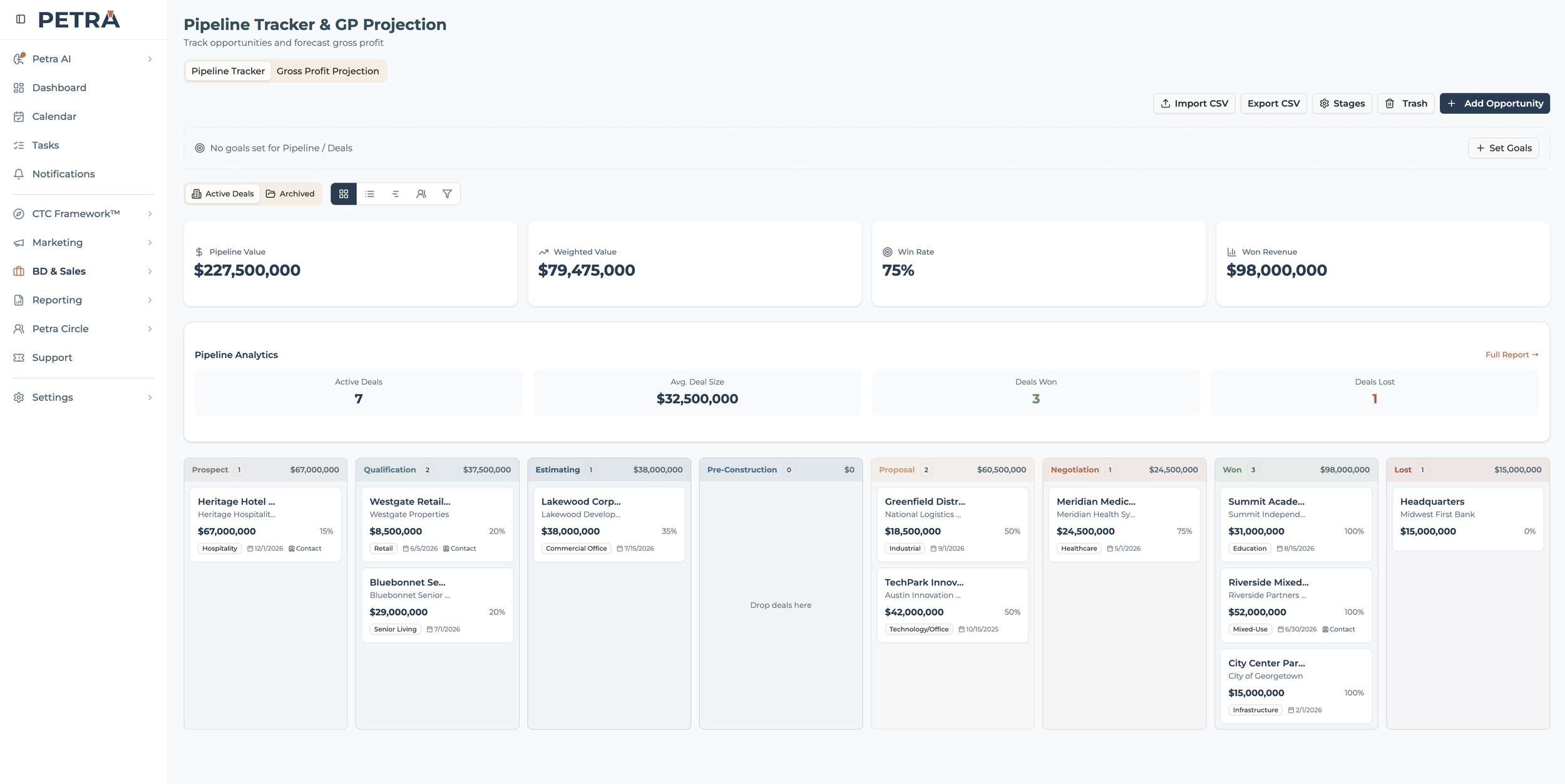
Petra was purpose-built for the specific demands of diversification in commercial construction. It's not a generic CRM or project management software. It's a system designed around how contractors pursue, win, and document work and how they cultivate the relationships that sustain a company over time. Here's where Petra directly addresses concentration risk:
Pipeline Visibility by Client and Sector
Petra's robust pipeline tracking provides an immediate, clear view of where your pursuits are concentrated by client, project type, delivery method, and stage. When you can see that 60% of your active pursuits involve a single owner, you're empowered to strategically redirect your BD efforts before that pattern becomes a structural vulnerability. Most firms lack this critical visibility, with their pipeline scattered across spreadsheets, emails, or individual memories. Petra centralizes it, making it visible, organized, and actionable.
A Contact Database That Compounds Over Time
Every relationship your company has ever touched—owners, developers, architects, engineers, subcontractors, suppliers, consultants—belongs in a system that links those contacts to your project history. Petra's contact records do exactly that. Each contact is connected to associated projects and pursuits, offering your team a comprehensive view of the relationship at a glance. When you're striving for diversification, this historical data is invaluable. It highlights dormant relationships, sectors you haven't engaged with in years, and contacts overdue for a conversation. Diversification begins with understanding your existing network.
A Project Library That Makes You Competitive in New Markets
A significant barrier to pursuing work in new sectors is the lack of readily available, professional project documentation. If your portfolio is buried in scattered folders or your best project photos are on someone's phone, you're at a disadvantage. Petra stores your completed project records—photos, renderings, floor plans, bid documents, insurance requirements, compliance documentation, scope descriptions, case study drafts, key data—all in one place. This allows your team to instantly pull what they need. When a new opportunity arises in a sector you haven't been active in for years, you have the resources to pursue it professionally and compellingly.
Petra AI as Your BD Guide
Not every commercial construction company has a seasoned BD director with decades of experience on staff. Petra AI guides your team through the strategy, content, and conversations necessary to build new relationships. The Content Hub generates proposal sections, case studies, and construction marketing content that persuasively positions your company in front of new audiences. This institutional knowledge doesn't disappear when senior personnel retire; it remains within the platform, easily accessible to your team.
Consistent Visibility That Builds New Relationships
Diversification demands that new clients either find you or are given a compelling reason to consider you. Petra's content and marketing tools help your company maintain a consistent, professional presence through case studies, thought leadership, and project storytelling. This consistent visibility gives unfamiliar owners a reason to reach out. The contractors who win negotiated work in new markets are rarely those who showed up once; they are the ones who were visible, consistently, long before the conversation even began.
The Business You’re Building Deserves to Stand on Its Own
Revenue concentration isn't a character flaw; it's a natural byproduct of an industry built on strong relationships and repeat business. However, left unaddressed, it leaves your company more fragile than it needs to be and worth less than it should be. The contractors who build truly durable companies take the time to understand their revenue sources, identify their exposures, and implement systems that proactively expand their relationship base before a crisis forces their hand.