

If you look at the marketing across 80 percent of commercial general contractors, every project case study looks nearly identical: three professional beauty shots of a completed project, the total square footage, the project delivery method, and a generic quote about safety and performing the project on budget and schedule.
Those portfolio photos look great on an award board, but sophisticated commercial owners and owner's reps rarely select a construction partner based on what a building looks like when the ribbon gets cut.
Owners choose contractors based on how effectively they navigate the unpredictable friction that occurs between groundbreaking and substantial completion. They want to know how your superintendent resolved a three-week structural steel delivery delay without blowing the critical path schedule. They want to understand how your precon group caught an MEP clash during BIM coordination that saved the owner $180,000 in change orders before concrete was poured. They want to see evidence that your project managers maintain active, collaborative communication with specialty subcontractors when site logistics become congested on a tight urban footprint.

When you shift your project storytelling from polished finished photography to transparent construction problem-solving, you demonstrate the exact operational competence that justifies your fee and protects your margins during selection interviews.
Owners do not hire contractors because construction is easy. They hire the team that demonstrates they know how to lead when a project gets complicated. Owners select the contractor who manages the risk the best. So, how do you communicate this to prospective owners?
You tell the story the way owners evaluate it, with the CSR Framework. CSR (Challenge, Solution, Result) is a simple structure for project stories that win work. Start with the problem your client faced, show how your team solved it, and prove the outcome with numbers. Used consistently, it turns every completed project into evidence that owners, architects and owner's reps can trust.
Why does most construction content fail to win work?
Beauty shots are only the first problem. Three other habits keep good companies invisible:
We list features every competitor lists. BIM, a strong safety record, experienced superintendents. Owners hear the same list from everyone on the bid list. (More on that in Why Quality and Safety Aren't Differentiators.)
We claim instead of prove. “On time and on budget” is an expectation, not evidence. On a multimillion-dollar decision, owners are evaluating risk, and claims don't lower it. Proof does. (Your Capabilities Statement Isn't Winning Work goes deeper.)
Our content doesn't connect. The case study, the LinkedIn post, the proposal insert and the website page each tell a slightly different story, so none of them builds on the others.
The result is content that blends in, generates few qualified leads, and pushes you right back into competing on price.
What is the CSR Framework?
CSR gives every project story the same three-part spine. It works for case studies, but also for blog posts, proposal narratives, LinkedIn posts and shortlist interviews.
1. Challenge: start with the hard part. Name a specific problem your ideal client recognizes. Not “the owner needed a building,” but “keeping a hospital wing fully operational during a phased renovation” or “hitting a fixed budget on a tight urban site with a zoning variance pending.” If an owner reads your first two sentences and thinks that's exactly our situation, you've earned the next paragraph.
2. Solution: show your team as the guide. The client is the hero of the story. Your team is the experienced guide who got them through it. This is where your capabilities finally mean something, because they're attached to a real decision. Don't just say “we self-perform” or “we're great at scheduling.” Say how your team resequenced the work around a late switchgear delivery and still hit the owner's move-in date.
3. Result: prove it with a number. This is the part most contractors leave out, and it's the part owners remember. Days saved, dollars saved, a shutdown that didn't happen, a repeat contract that followed. Something like “finished 18 days early, saving the owner $225,000 in carrying costs” does more work than any adjective you'll ever write.
A shortcut for getting the story out of your project team. Your PMs and superintendents have these stories. They just don't think of them as extraordinary because they deal with them everyday. They don’t see the marketing value either, but the anecdotes and details are solid gold. Ask them three questions after closeout:
What almost went wrong on this job?
What did we do that another contractor might not have?
What changed for the owner because of it, and can we put a number on it?
Those three answers are your Challenge, Solution and Result.
What does CSR do for each person on your team?
For the owner or CEO: Project knowledge stops living in one person's head. When a PM or business developer leaves, the proof stays. And when your content shows problems solved instead of buildings finished, you give owners a reason to choose you on value, not price.
For business development: You walk into every pursuit with a library of proof matched to that owner's situation. That's often the difference on a close shortlist. (See The Proposal Gap.)
For marketing: No more blank page. Every project story follows the same structure, so you produce more, faster, and you can finally show leadership which stories helped win work.
How does one project become a month of content?
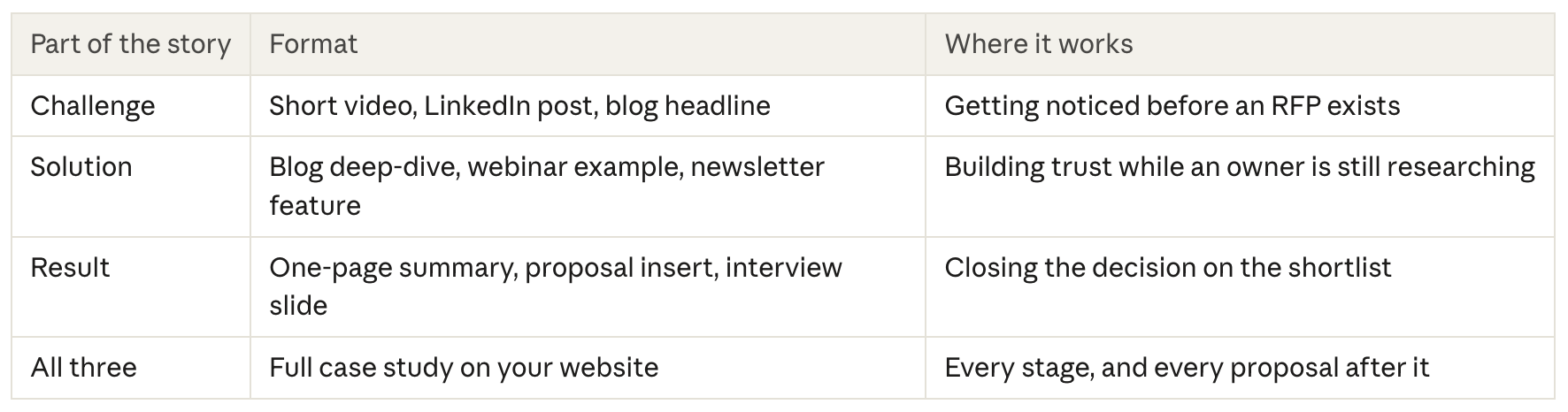
Each part of the story fits a different moment in an owner's decision. Write the full story once, then break it apart. The chart below explains the many ways you can use the same content across various platforms. I walk through this in more detail in How to Turn One Construction Project Into a Wealth of Marketing Content.
Where should you start?
Pick one project you finished in the last 12 months. Ask your PM and the Superintendent the three questions. Write a single page: one paragraph each for Challenge, Solution and Result. That's it. You now have the raw material for a case study, three LinkedIn posts, a proposal insert, a website project profile, and a better answer the next time an owner asks, "Have you done this before?"
To make it faster, download the free CSR Content Builder Template. It gives your team a set of detailed prompts for capturing a project story, so nobody starts from a blank page. And if you want the stories to live somewhere your whole team can find them, Petra's Project Portfolio keeps each project's photos, details and story in one place, ready to pull into the next proposal. Start a 7-day free trial and put your first story in it this week.
Your completed projects already prove what you can do. CSR just makes sure owners hear it before they start comparing you to everyone else.
FAQs
What does CSR stand for in construction marketing? CSR stands for Challenge, Solution, Result. It's a three-part structure for project stories: the problem the client faced, how the contractor solved it, and the measurable outcome.
How is a CSR case study different from a project profile? A project profile describes the building: size, type, schedule. A CSR case study describes the problem solved and proves the outcome with numbers, which is what owners use to judge risk.
What if we don't have hard numbers for a project? Ask the project manager what changed for the owner. Days saved, a shutdown avoided, a change order prevented or a repeat contract all count. A specific outcome beats a general claim.
Who should write CSR stories at a construction company? Marketing usually writes them, but the raw material comes from project managers and superintendents. Three questions after closeout are usually enough: what almost went wrong, what you did differently, and what changed for the owner.
